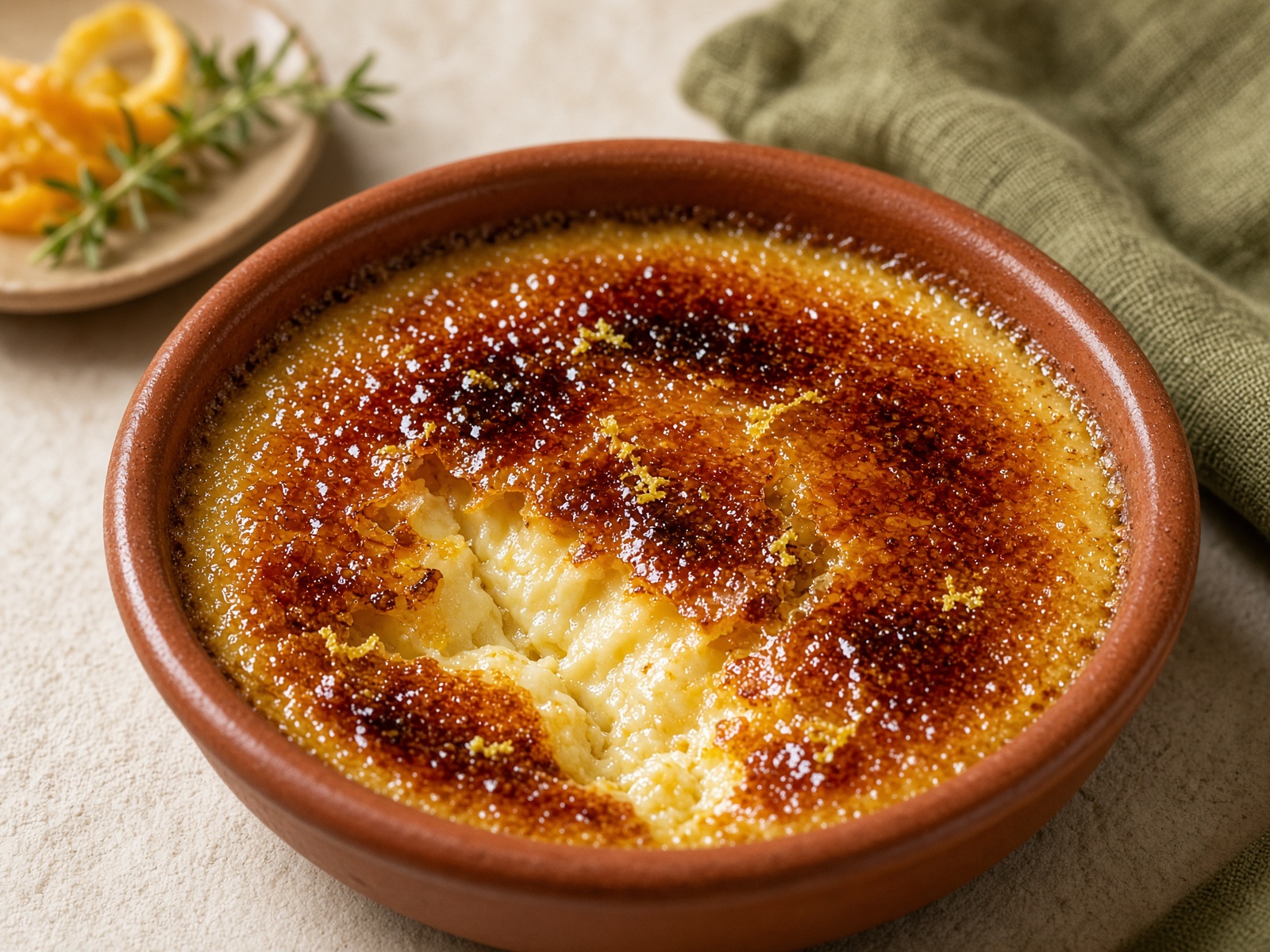
You want a crack of glass and, beneath it, a cream just set: a stove-top custard thickened with yolks and starch, scented with lemon peel and cinnamon, then branded with a hot iron. It is served in a shallow cazuelita. Not a baked custard.
Catalonia's cream is a different animal from the French one it is often compared to: no oven, no vanilla, the burn done with a branding iron still called a hierro. It is the dessert of Saint Joseph's day, and of any lunch that needs a burnt lid.
Burn the sugar at the table if you can. A Moscatel from Empordà, or Cava. Serve at once, before the caramel weeps. Don't lay the sugar on in a slab; a thin even dusting is what you want.
Method
- 01
Warm the milk with the lemon peel and cinnamon stick until it just steams — don't let it boil. Take it off the heat and let it infuse 10 minutes, so the cream will taste of lemon and spice, not of vanilla. Fish out the peel and the stick. This is a stove-top cream, Catalan, and those two aromatics are all the perfume it wants.
- 02
Whisk the yolks with the ½ cup of sugar and the cornstarch until the mixture is pale and thick. Pour on the warm milk in a steady stream, whisking constantly so the yolks don't scramble. Return the lot to a clean pan. You should have a smooth, lemon-scented custard base, ready for the heat.
- 03
Cook over medium-low heat, stirring constantly — a wooden spoon, and into every corner of the pan — until the cream thickens and coats the back of the spoon, 5 to 7 minutes. Do not let it boil, or you'll have sweet scrambled eggs. When you can draw a line through the cream on the spoon and it holds, you're there.
- 04
Divide the cream among four shallow cazuelitas. Let them cool to room temperature, then chill at least 4 hours, until the cream is just set. It should tremble slightly, not stand up like a baked custard. Cold and just set is what you want beneath the caramel.
- 05
Dust each cream with a thin, even layer of sugar — thin is important, or the caramel will be a slab. Burn it with a hot iron or a blowtorch until the caramel is mahogany and glass-hard. Serve at once, before the caramel weeps. The crack should be glass and the cream beneath just set; burn it at the table if you can.